


Motorcycle racing legend Mert Lawwill known for innovation beyond the track


Mert Lawwill, a Tiburon resident for more than 50 years whose career as a championship-winning motorcycle racer and mountain-bike pioneer earned him induction into multiple halls of fame, died in Meridian, Idaho, on May 6. He was 85.
His son, Joe Lawwill, confirmed his father’s death in a May 19 interview, though he did not provide a specific cause of death.
Lawwill’s professional career began in 1963, and he joined the Harley-Davidson factory racing team the following year. He reached the pinnacle of his racing career in 1969, when he won the American Motorcyclist Association Grand National Championship and was voted the association’s most popular rider.
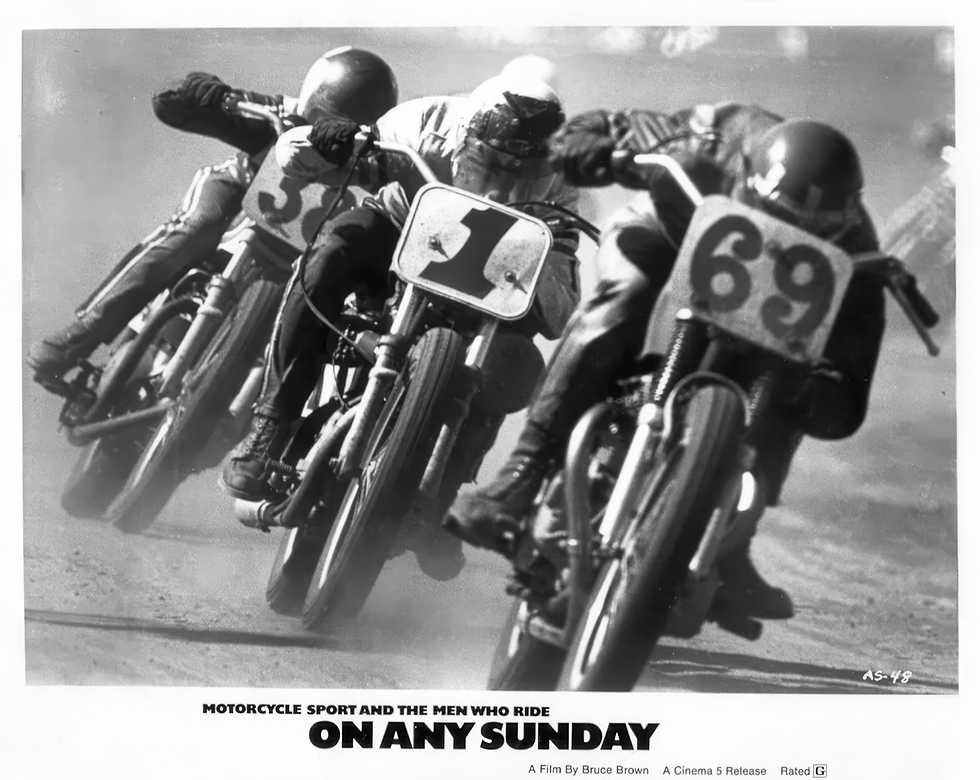
His 1970 title defense was chronicled in the 1971 documentary “On Any Sunday,” directed and narrated by Bruce Brown, who also directed “The Endless Summer.” The film also featured actor and avid motorcyclist Steve McQueen, who provided funding for the documentary through Solar Productions, his production company.
“There are only a handful of people in the world who have the courage and skill to ride a motorcycle like Mert and these professionals,” Brown said in the film’s narration, which described Lawwill as “a gentleman in a violent world.”
The film was nominated for Best Documentary Feature at the Academy Awards in 1972 and has since achieved cult status. It “does for motorcycle racing what ‘The Endless Summer’ did for surfing,” film critic Roger Ebert wrote in a 1971 review.
After retiring in 1977, Lawwill shifted his attention to designing and building motorcycle race-bike frames that became the benchmark in dirt-track racing through the 1970s and 1980s.
Lawwill also pursued mountain biking, developing one of the discipline’s first production bicycles, the Lawwill Knight Pro Cruiser, about 1978. Four-bar suspension designs he created were later used by Schwinn and Yeti Cycles. He also designed Mert’s Hands, a prosthetic that allows riders who have lost an arm or hand to grip the handlebars and quickly disengage from bikes or motorcycles.
Lawwill’s success as a racer and innovator led to induction into the Mountain Bike Hall of Fame in 1997 and the AMA Motorcycle Hall of Fame in 1998.
On the track and beyond
Lawwill was born in Idaho and moved to Los Angeles at age 21 in 1961 or ’62 — his own accounts vary — setting his sights on the Ascot Park dirt speedway, where he competed in its Friday night flat-track races alongside Yeti Cycles founder John Parker.
“Mert was just a Friday night god,” Parker told Freehub in a July 2020 feature. “This giant of a man — for the movie, for having had the No. 1 plate, for being a factory Harley-Davidson rider — Mert was just on top of his game.”
After going pro in 1963, Lawwill won his first national race at the Sacramento Mile in 1965, a victory he described as his most satisfying in a 1977 interview.
In 1969, he accumulated the most points across 27 races, earning the national championship and the No. 1 plate on his motorcycle.
A 2017 CycleNews retrospective called Lawwill’s 1969 championship a surprise victory, describing him as “not flashy, but an all-around talent who was a contender on any of the five types of races”: miles, half-miles, Tourist Trophy, short tracks and road races.
Across his career, Lawwill won 15 Grand National races and logged 161 Grand National finishes. AMA Pro Racing, in a news release honoring Lawwill, described him as someone who “combined rare mechanical understanding with a smooth, determined riding style that made him one of the sport’s most admired competitors.”
“Mert Lawwill’s career embodied the full spirit of American flat track: courage, creativity, independence and relentless pursuit of speed,” the organization said. “AMA Pro Racing remembers him not only as a Grand National Champion, but as a builder, pioneer, ambassador and beloved member of the racing family.”
Lawwill, who always did the mechanical work on his own bikes, told The Ark in 1976 that each win was two victories in one: “One for racing the best race, and another for maintaining a superior machine.”
After an inner-ear disorder affected his balance, Lawwill retired in 1977. He maintained a connection to racing through design and engineering, applying those same principles to develop mountain-bike suspension systems, including a leading-link front fork called the Lawwill Leader.
“Even though the term ‘mountain bike’ wouldn’t be coined for another four years, Mert’s bike is widely considered to be the world’s first production mountain bike,” Cycle World wrote in a May 7 remembrance. “Like so many other motorcyclists who took to this new form of off-road riding, Mert too realized that if they wanted to go faster, these fat-tired bicycles could use some suspension.”
Joe Lawwill said his father ran motorcycle race teams, and the two traveled the country on the racing circuit together, where Joe observed his father working and developing the bikes alongside racers.
“He was just real methodical with learning stuff,” Joe Lawwill said. “He was an engineer by just hands-on … seeing things and learning from them.”
Lawwill’s proudest accomplishment, The Ark reported in 2008, was developing prosthetics that allow bicycle and motorcycle riders missing an arm or hand to still ride. The idea came after fellow Harley-Davidson racer Chris Draayer lost his left arm in a racing accident in 1967.
Freehub reported that more than 300 people were using the prosthetic, and Lawwill noted that despite the small number of riders, it has a significant impact on them.
“It really changes their life because it gets them back on wheels again,” he told Freehub.

Early and local life
Merton Randolph Lawwill was born Sept. 25, 1940, in Boise, Idaho, the second youngest of seven children. His father, Randolph, was a miner and housepainter; his mother, Thelma Irish, was a schoolteacher. He graduated from Boise High School in 1959.
A news release announcing his death described Lawwill in his youth as “never one to follow the rules” and always looking for a reason to skip his chores. He was introduced to motorcycling by his older brother Roy, who brought home a Corgi, a British-made, 98cc folding scooter designed to be tossed out of airplanes for military use, Freehub reported.
“Everybody in my family, they were all achievers,” Lawwill told Freehub. “They could all play musical instruments, or they were artists — except me. I couldn’t do very much. I tried to play the clarinet for five years, but … I just had interest in wheels.”
Lawwill recalled in a July 1977 interview with American Motorcyclist magazine that his family initially resisted his motorcycling ambitions, leading to fights and discipline problems until they relented.
“We had a lot of fights about it and some discipline problems with me,” Lawwill said at the time. “The problems were finally resolved when they let me have a motorcycle!”
While living in Los Angeles, Lawwill enrolled at El Camino Junior College and Los Angeles Trade-Technical College, though his ambitions lay elsewhere.
“I think I might be a classic example of someone who takes a sport and makes a vocation out of it,” he said in a 2008 Ark article.
Lawwill purchased land on Rock Hill Road in 1968 and built a home there in 1969, where he and his wife, June, raised their two children, Joe and Marcella. He remained in Tiburon until fall 2024, when he moved back to Idaho to be near his five sisters.
When Lawwill arrived in Tiburon, his son said, there were only four homes on the street, and Lawwill could ride his motorcycle across Tiburon’s open space to Corte Madera.
“He loved that it was away from the city but … amazing views, and just he loved the open space, and he could ride his motorcycle,” Joe Lawwill said, adding that “obviously, that changed in time.”
Although Joe Lawwill said his father’s racing career kept him away early on, Lawwill always made time for whatever his kids had going on, such as helping build pinewood derby cars for Cub Scout races.
Despite the fame he achieved throughout his career, Lawwill “never big-timed anybody,” his son said.
“When we did our posts on Facebook and Instagram … it’s just endless posts of like, ‘Man, I met your dad, he was so gracious with his time, he took pictures,’” Joe Lawwill said, adding that his father never treated fans like fans. “He always treated them just like a friend.”
Joe Lawwill said his father, above all, was “intent on making things better,” whether it was for his racing teams or for those who needed a prosthetic to ride.
Mert Lawwill “wasn’t just a racer,” his son said. “That’s what he’s most well known as, but he’s not just a racer.”
Lawwill is survived by son Joe Lawwill; daughter Marcella Lawwill; stepsons Rick, Mike and Tim Suchomel; three grandchildren; and siblings Carolyn Dunlap, Leroy “Roy” Lawwill, Anna Lawwill Culmer, Marian Nakagawa, Donna Call and Mary Pribble.
He was preceded in death by wife June Lawwill, who died in 2018, and his parents.
A public celebration of life is planned for Aug. 30 at the Carson Event Center in Carson, California, though registration will be required. More information will be published on Lawwill’s social-media pages.